



How Contractors Can Unlock Labor Savings in Data Center Projects
Mission Critical Team, Acuity Brands Lighting

The Labor Challenge in Data Centers
Time is one of the most persistent constraints in data center construction. These pressures manifest in many ways, from accelerated build schedules to limited labor availability. Fortunately, solving time-related challenges often comes down to a few proven choices: adding more labor, committing to fewer projects or increasing capacity through productivity improvements. But do you really have a choice? Done correctly, the latter helps your team manage expenses, maximize revenue and keep projects on schedule.
Growing demand for computing power is driving tech companies to place increased pressure on the construction ecosystem to meet aggressive project timelines. To further complicate things, these spaces are complex. The electrical infrastructure is highly engineered, and its installation demands careful coordination and expertise. So, how do you navigate fast-paced, complex projects with multiple trades coordinating work in a confined space? Strategic manufacturer partnerships can aid in planning and execution, helping simplify the installation of lighting and lighting controls, so you can move on to your next task more quickly.
Standardizing for Productivity
The benefit of standardization across the lighting and lighting controls package should not be ignored. Developing a ‘go-to’ solution that is predictable and repeatable reduces errors and allows the team to scale. Additionally, it enables manufacturer visibility into critical supply chain needs to help align product availability with project timelines.
When it comes to lighting and lighting controls, there are many ways to reduce installation time and labor costs. In most cases, these labor-saving solutions are adaptable and support the contractor wherever the work is best performed, whether in a prefabrication shop or through on-site installation. In addition to saving installation time, these solutions reduce variability, helping promote more predictable outcomes. Let’s look at these labor-saving approaches:
Electrical: Every luminaire requires power; make the wiring connection as easy as possible.
· Flex-conduit whips (recessed ceilings): Lay-in luminaires, such as grid-ceiling troffers, can be pre-wired with whips made from flexible metal conduit (FMC) and a conductor combination of your choice. The most common configuration uses 18 AWG wires in a single-circuit, or two-circuit setup to accommodate emergency battery packs or 0-10V dimming.
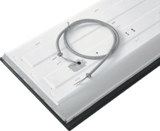
· Cord sets (open ceilings): Take advantage of factory-equipped cord sets on high-bays or strip lighting. These cord sets are available in multiple lengths, conductors, and plug or no-plug configurations.
· Modular wiring systems: Today’s modular wiring solutions, such as RELOC™, allow for plug-and-play functionality from the breaker panel through the entire building. Luminaires can be ordered with mating connectors, making modular wiring one of the fastest and most predictable ways to wire a space. In fact, modular wiring can reduce wiring labor, by up to 70% in some applications, compared to traditional MC cable. Ideal for colocators and hyperscalers, RELOC allows flexibility to reconfigure the space as needed, making it a highly adaptable wiring choice.
Hardware: Luminaire Mounting Methods and Best Practices
· Hanging brackets: Linear, strip lighting is pervasive throughout data center halls. Tong hanger brackets make it simpler to mount luminaires to an on-site structure or pre-fab metal framing system. These adaptable brackets mount almost anywhere along the length of a linear luminaire making them highly versatile.
· Linear Fixtures and Troffers: Linear fixtures integrate into ceiling systems, while troffers lay directly into the ceiling grid system.
Luminaires: Modified Fixtures to Fit within the Grids
Ceiling grid luminaire compatibility is a common source of jobsite delays. Ordering luminaires designed to fit seamlessly within data center specific grid systems eases delays, reduces installation time and can help crews stay on schedule.
When fixtures are engineered to match the grid system from the start, contractors gain several labor‑saving advantages:
- Elimination of field modification
- More predictable installation rates
- Supports prefabrication strategies through pre-built assemblies allowing contractors to shift labor off-site
If contractors share project‑specific grid details early (i.e. grid manufacturer name and model), lighting manufacturers can help ensure the selected luminaires drop cleanly into place – helping reduce installation complexity and variability and creating a more repeatable workflow for data center buildouts. Acuity Brands Lighting supports this approach by offering troffers and linear fixtures custom designed around grid specifications.
Embedded Controls and Emergency
Embedded Controls refer to luminaires that include a sensor and an emergency driver within the luminaire. Luminaires with embedded controls are designed, manufactured, tested and shipped with the controls and emergency driver factory-installed.
A lighting control sensor embedded within a luminaire provides occupancy detection delivering energy savings and helps address applicable code requirements. An emergency driver factory installed in a luminaire provides battery back-up and a test switch on the luminaire. Key benefits include constant lumen output over the required 90-minute runtime, and user-selectable self-testing and diagnostics.
With fewer devices to install and commission, luminaires with embedded controls reduce installation time on the jobsite.
Packaging: Designed for the Realities of the Jobsite

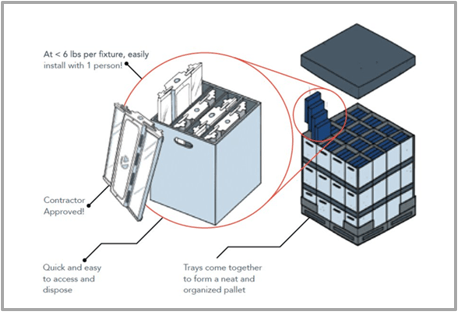
· Job quantity packaging: Data centers are typically large spaces, making ‘job packs’ a great candidate to reduce labor burden. Job packs support pallet-sized quantities, where optimized packaging reduces jobsite waste and cleanup. Job pack quantities and pallet configurations can be found on the manufacturer’s specification sheets.
Conclusion
These labor-saving options can be used individually or together, giving contractors flexibility in how they’re applied. Many can be deployed either onsite or within a prefabrication environment, helping crews work more efficiently with fewer disruptions. The result is a more predictable, high‑quality installation experience that enables teams to accomplish more within the same schedule.
Standardizing with Acuity Brands Lighting means using products designed for demanding environments backed by an industry leader with extensive production capabilities to help meet the client’s accelerated timeline.
With dedicated resources, Acuity supports standardization, speed, schedule, and provides consistent pricing. Contact our Mission Critical Team today.


